- Replace high-maintenance lawn areas with native groundcovers or hardscaping to cut weekly work by 50%+
- Smart irrigation controllers reduce watering effort to near-zero while cutting water bills 30-50%
- Mulch beds with 3 inches of organic material to suppress weeds and retain moisture
- Choose disease-resistant, Zone 6b-proven plant varieties that thrive without pampering
- One professional design investment saves hundreds of hours of maintenance over the life of the landscape
Let us be honest. You did not buy a home in Clinton, Framingham, or Natick so you could spend every Saturday mowing, weeding, watering, and fertilizing. You bought it so you could enjoy it — cookouts on the patio, reading in the shade, watching your kids play in the yard. But traditional landscaping has a way of turning homeownership into a second job.
The good news? It does not have to be that way. Low-maintenance landscaping is the fastest-growing trend in Metro West Massachusetts, and for good reason. Modern landscape design offers beautiful, functional outdoor spaces that require a fraction of the time, water, and money that conventional yards demand.
This guide covers everything you need to know about creating a low-maintenance landscape that looks great year-round — without sacrificing your weekends.
What Does "Low-Maintenance" Actually Mean?
Low-maintenance landscaping does not mean "no maintenance." Every outdoor space needs some care. What it means is designing your landscape so that routine upkeep is minimal, predictable, and manageable. Instead of weekly mowing, constant watering, seasonal replanting, and endless weeding, a well-designed low-maintenance landscape might need attention once or twice a month during the growing season and almost none during winter.
The core principles are simple:
- Right plant, right place. Choose plants adapted to your specific conditions — sun, shade, soil type, moisture level. Plants in their ideal environment thrive without intervention.
- Reduce lawn area. Traditional lawns are the single most labor-intensive element of any landscape. Every square foot of lawn you replace with beds, groundcovers, or hardscape reduces your weekly workload.
- Use perennials over annuals. Perennials come back year after year. Annuals die and must be replanted every spring. Fill your beds with perennials and you eliminate hours of spring planting.
- Mulch strategically. A proper 2-3 inch mulch layer suppresses weeds, retains moisture, and reduces watering — three maintenance tasks handled by one material.
- Invest in hardscape. Patios, walkways, and stone features require zero mowing, zero watering, and zero fertilizing. They look great for decades with virtually no upkeep.
The Hidden Cost of Traditional Landscaping
Before we dive into solutions, let us quantify what traditional landscaping actually costs in time and money for a typical Metro West home:
Time Investment (Per Year)
- Mowing: 30-35 sessions × 1-2 hours = 30-70 hours
- Edging and trimming: 30 sessions × 20 minutes = 10 hours
- Watering management: Adjusting sprinklers, moving hoses = 10-20 hours
- Weeding: Spring through fall = 20-40 hours
- Fertilizing: 4-6 applications × 1 hour = 4-6 hours
- Leaf cleanup: Fall = 10-20 hours
- Spring and fall cleanup: 5-10 hours each = 10-20 hours
- Planting annuals: Spring = 4-8 hours
Total: 100-180 hours per year — that is 2.5 to 4.5 full work weeks spent on your yard.
Financial Cost (Per Year)
- Mowing (DIY): Gas, maintenance, blade sharpening = $200-400
- Mowing (professional): $45-65/visit × 30 visits = $1,350-1,950
- Water: Irrigation = $300-800
- Fertilizer and chemicals: $200-500
- Annuals and mulch: $300-600
- Equipment: Mower, trimmer, blower maintenance = $100-300
Total: $1,100-4,550 per year for a standard suburban lot.
A low-maintenance landscape can cut both time and money by 50-70 percent. Here is how.
Strategy 1: Shrink Your Lawn
The single most impactful change you can make. Traditional lawns require mowing every 5-7 days during the growing season, regular fertilization, weed control, watering, aeration, and overseeding. No other landscape element demands this level of constant attention.
What to Replace Lawn With:
Groundcover Plantings
Replace sections of lawn with spreading groundcovers that never need mowing:
- Creeping Thyme (Thymus serpyllum) — Fragrant, purple-flowering, walkable, drought-tolerant. Perfect between pavers or as a lawn substitute in sunny areas.
- Wild Strawberry (Fragaria virginiana) — Native, produces small edible berries, white spring flowers. Spreads quickly to fill areas.
- Pennsylvania Sedge (Carex pensylvanica) — Native grass-like groundcover for shade. Looks like a fine-textured lawn but needs mowing only once per year (or never).
- Creeping Phlox (Phlox subulata) — Stunning spring carpet of pink, purple, or white flowers. Evergreen foliage year-round.
Tapestry Lawns
The hottest trend in 2026 landscaping — a mix of low-growing plants (clover, thyme, self-heal, violets) that creates a living carpet. Unlike a monoculture grass lawn, tapestry lawns:
- Need mowing only 2-4 times per year (vs. 30+ for traditional grass)
- Never need fertilizer (clover fixes nitrogen from the air)
- Attract pollinators with their flowers
- Stay green through drought (deeper root systems than grass)
- Handle foot traffic
Expanded Garden Beds
Widen your existing beds by 3-5 feet. Fill with low-maintenance perennials and shrubs. Every square foot of bed is a square foot you never mow again.
Hardscape
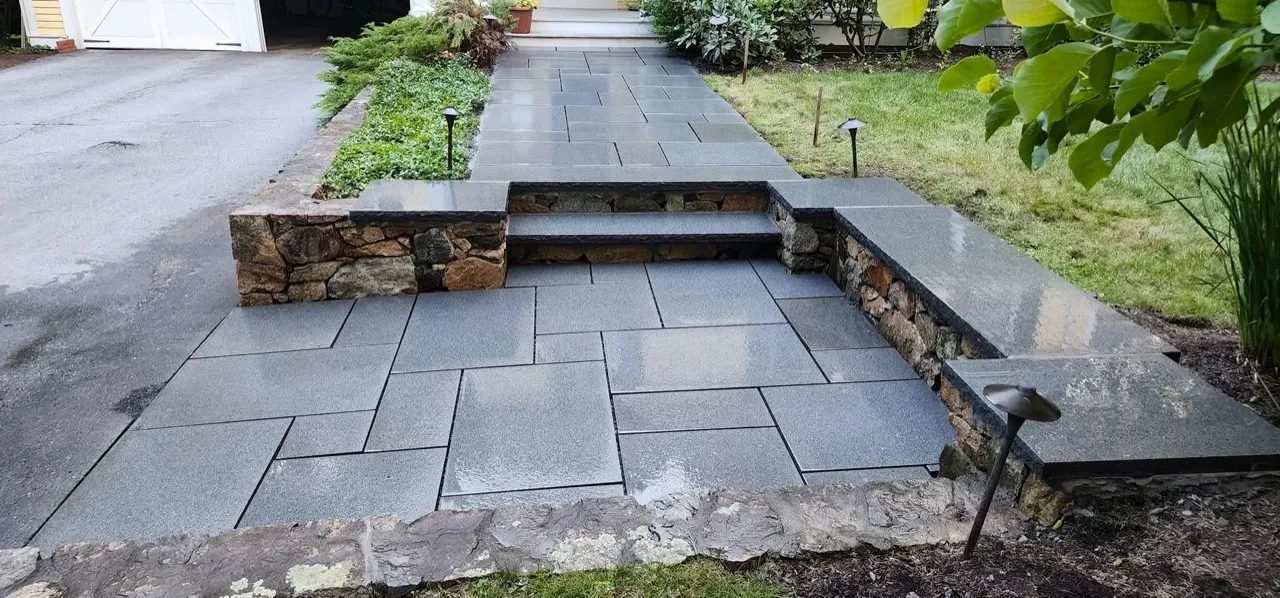
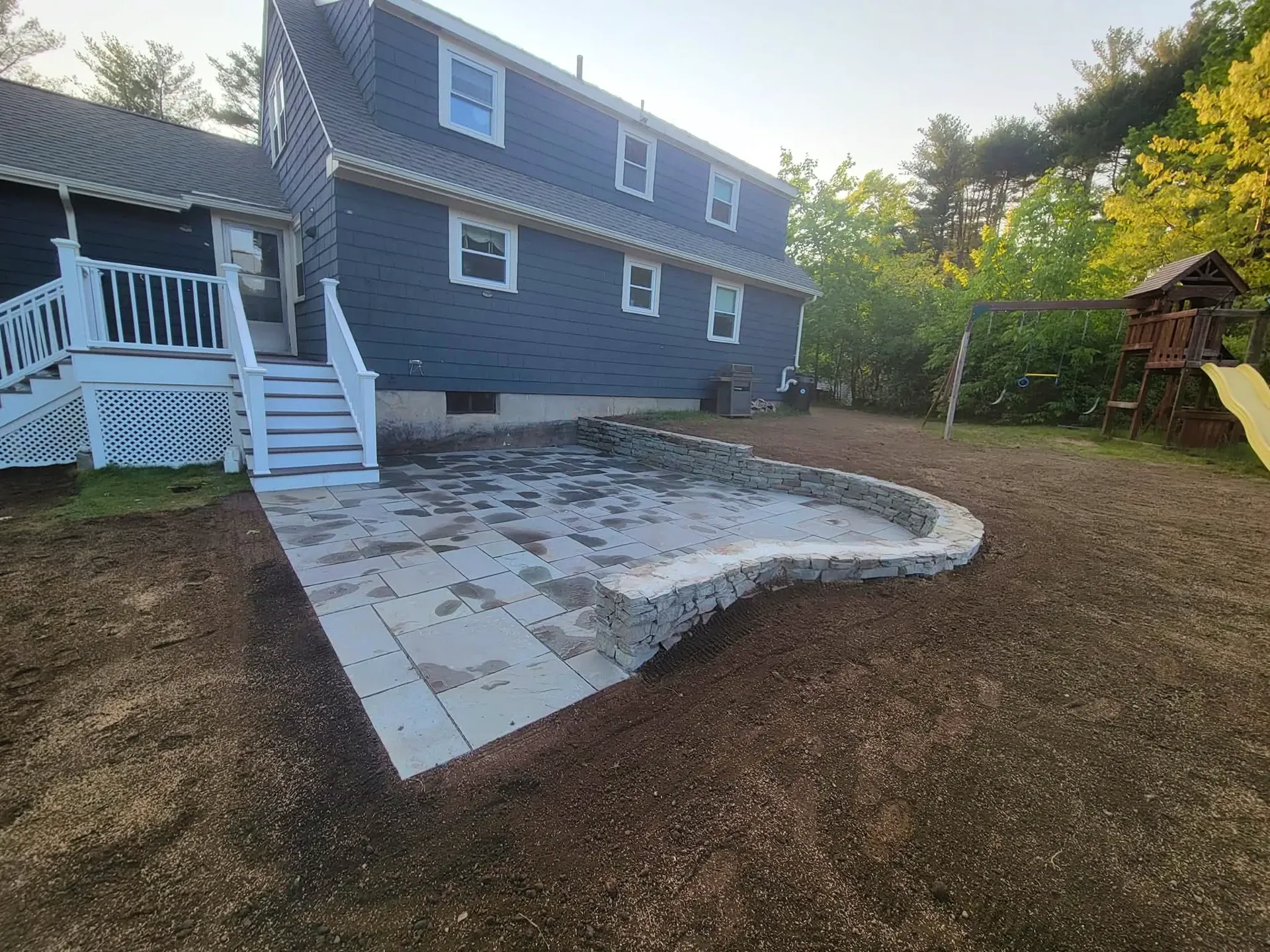
Extend your patio, add a walkway, create a gravel sitting area. Stone, pavers, and gravel need essentially zero maintenance for 25+ years.
How Much Lawn to Keep?
You do not need to eliminate all grass. A smaller, well-maintained lawn surrounded by beds and hardscape can be more attractive than a large, struggling lawn. Consider keeping grass in these areas:
- Play areas for children and pets
- A central "green room" for gatherings
- Functional pathways between spaces
Target: Reduce lawn area by 30-50 percent. This alone can cut your mowing time in half and dramatically reduce water use.
Strategy 2: Choose Plants That Practically Care for Themselves
The key to a low-maintenance garden is selecting plants that are naturally suited to your conditions. In Metro West Massachusetts (USDA Zone 6b), that means plants that handle:
- Cold winters (down to -5°F to 0°F)
- Hot, humid summers
- Variable rainfall
- Acidic soil (pH 5.5-6.5, typical of the region)
Our Top Low-Maintenance Perennials for Metro West
Full Sun:
- Daylilies (Hemerocallis) — Plant them and forget them. Dozens of color options, bloom for weeks, spread to fill space, virtually pest-free. The ultimate "no-fail" perennial.
- Sedum (Stonecrop) — Succulent foliage, drought-proof, attracts butterflies. Varieties from 3-inch groundcovers to 2-foot tall 'Autumn Joy.' Never needs watering once established.
- Russian Sage (Perovskia atriplicifolia) — Silvery foliage, lavender-blue flower spires from July through frost. Drought-tolerant, deer-resistant, disease-free. Looks elegant with zero effort.
- Catmint (Nepeta) — Blue-purple flowers from May through September if you shear it once midsummer. Deer-proof, drought-tolerant, and the bees love it.
- Ornamental Grasses (Panicum, Miscanthus, Calamagrostis) — Movement, texture, and year-round interest. Cut back once in early spring — that is your entire maintenance program. Karl Foerster feather reed grass is the most popular upright variety.
Shade:
- Hostas — The undisputed queen of shade gardens in New England. Hundreds of varieties from miniature to enormous. Bold foliage in blue, green, gold, and variegated. Virtually indestructible.
- Astilbe — Feathery plumes of pink, red, white, or purple in midsummer. Thrives in the moist, shady conditions where most plants struggle.
- Ferns (Osmunda, Athyrium, Dryopteris) — Native ferns are the definition of low-maintenance shade plants. They appear in spring, look beautiful all summer, die back in fall, and repeat forever. No feeding, no watering, no pests.
- Brunnera (Siberian Bugloss) — Heart-shaped silver-spotted leaves, tiny blue forget-me-not flowers in spring. Gorgeous groundcover for dry shade — the hardest condition in landscaping.
- Heuchera (Coral Bells) — Colorful foliage in purple, lime, peach, silver, and burgundy. Evergreen or semi-evergreen. Compact size perfect for borders and containers.
Low-Maintenance Shrubs
- Hydrangea paniculata (Limelight, Little Lime, Quick Fire) — Massive white flower heads that age to pink. Blooms on new wood, so even a bad winter does not affect flowering. Tolerates sun to part shade. Prune once in late winter.
- Arrowwood Viburnum (Viburnum dentatum) — Native, white spring flowers, blue berries, red fall color. Adapts to any soil. No pruning needed. Birds love the berries.
- Inkberry Holly (Ilex glabra) — Evergreen native alternative to boxwood. No leaf drop, no disease issues, tolerates wet or dry. Dense and tidy without constant shearing.
- Ninebark (Physocarpus opulifolius) — Available in deep purple (Diabolo) or gold (Dart's Gold) foliage. White flower clusters in spring. Peeling bark for winter interest. Tough as nails.
- Itea (Virginia Sweetspire) — Fragrant white flower racemes in June, spectacular red-purple fall color. Native, adapts to wet or dry soil. Compact and tidy.
Strategy 3: Mulch Like a Professional
Mulch is the low-maintenance gardener's best friend. A proper 2-3 inch layer of quality mulch:
- Suppresses 90 percent of weed germination — dramatically reducing weeding time
- Retains soil moisture — reducing watering needs by 25-50 percent
- Regulates soil temperature — protecting roots from extreme heat and cold
- Breaks down into organic matter — improving soil health over time
- Looks clean and finished — instant curb appeal
Mulch Tips for Maximum Low-Maintenance Benefit:
- Apply 2-3 inches (not more — excessive mulch suffocates roots)
- Keep mulch 3-4 inches away from tree trunks and plant stems
- Refresh annually in late spring after soil warms
- Use hardwood or cedar mulch for longest-lasting coverage
- Edge beds cleanly before mulching for a sharp, professional look
One mulch application per year plus clean edges gives your landscape a well-maintained appearance with minimal effort.
Strategy 4: Smart Irrigation (Or No Irrigation)
Traditional irrigation systems run on timers, watering on schedule whether the plants need it or not. This wastes water and money. Low-maintenance landscapes take a smarter approach:
Option 1: Eliminate Irrigation Entirely
If you choose native and drought-tolerant plants, you may not need irrigation at all after the first establishment year. Native plants evolved with Massachusetts rainfall. They handle dry spells naturally. This is the ultimate low-maintenance water strategy — your water bill drops to zero for outdoor use.
Option 2: Smart Controllers
If you keep some lawn or have plants that benefit from supplemental water, upgrade to a smart irrigation controller (Rachio, Hunter Hydrawise, Rain Bird). These WiFi-connected controllers:
- Use real-time weather data to skip watering when rain is coming
- Adjust run times based on temperature and humidity
- Reduce water use by 20-40 percent vs. fixed-schedule timers
- Are controllable from your phone — no more running outside to adjust
Option 3: Drip Irrigation for Beds
If you water garden beds, switch from spray heads to drip irrigation. Drip delivers water directly to root zones with near-zero waste from evaporation or overspray. Set it and forget it.
Strategy 5: Design for Year-Round Interest Without Year-Round Work
A common concern about low-maintenance landscaping is that it will look boring or neglected. The opposite is true when designed properly. A well-planned low-maintenance landscape has something beautiful happening in every season:
Spring: Flowering trees (serviceberry, redbud), bulbs (daffodils — they come back forever and deer avoid them), early perennials (columbine, bleeding heart)
Summer: Mass plantings of daylilies, ornamental grasses starting to sway, hydrangeas in full bloom, butterfly weed attracting monarchs
Fall: Grasses at peak beauty with golden plumes, sedum flowers deepening to copper, aster and goldenrod providing late-season color, shrubs turning red and orange
Winter: Evergreen shrubs (inkberry, rhododendron), red winterberry berries against snow, ornamental grass seed heads catching frost, beautiful bark on birch and red twig dogwood
The key is selecting plants with multiple seasons of interest. A winterberry holly, for example, has spring flowers, summer foliage, fall color, AND winter berries — twelve months of beauty from one plant.
Strategy 6: Hardscape as the Backbone
The most maintenance-free element in any landscape is hardscape — patios, walkways, retaining walls, and stone features. Once installed, quality hardscaping:
- Needs zero mowing, watering, or fertilizing
- Looks great for 25-50+ years
- Provides functional space for living, dining, and entertaining
- Increases property value by 15-20 percent
- Defines spaces and reduces the plantable area that needs care
High-Impact, Low-Maintenance Hardscape Ideas:
- Expand your patio to create a generous outdoor living room
- Add a gravel path through garden beds (gravel needs only occasional raking)
- Build a seat wall around a fire pit for autumn gatherings
- Install stepping stones through groundcover (eliminate a mown path)
- Create a dry stream bed to handle drainage AND add visual interest
Every dollar spent on hardscape is a dollar that reduces your lifetime maintenance burden.
What Will This Cost?
Low-maintenance landscape renovations in the Metro West area typically cost:
Small Projects ($2,000-$5,000):
- Convert 1-2 garden beds to native/low-maintenance perennials
- Add mulch and edging throughout
- Replace a section of lawn with groundcover
Medium Projects ($5,000-$15,000):
- Reduce lawn by 30-40 percent
- Install 2-3 new perennial beds with native plants
- Expand patio or add walkway
- Upgrade irrigation to smart controller or drip
- Professional design plan
Large Projects ($15,000-$40,000+):
- Comprehensive landscape renovation
- Significant hardscape additions
- Major lawn reduction with meadow or tapestry lawn
- Native plant design throughout
- Full irrigation redesign or removal
The Math That Matters: Long-Term Savings
A typical $10,000 low-maintenance renovation pays for itself within 3-5 years through:
- Reduced water bills: $300-800/year saved
- Eliminated or reduced professional lawn care: $500-2,000/year saved
- Reduced fertilizer, chemicals, and annuals: $200-500/year saved
- Time saved: 50-100+ hours per year (what is your time worth?)
Total annual savings: $1,000-3,300 per year — plus 50-100 hours of your life back.
Common Mistakes to Avoid
1. Going too minimal too fast. A yard of nothing but mulch and three shrubs looks barren. Low-maintenance does not mean empty. Use mass plantings of a few reliable species for impact.
2. Ignoring the establishment period. Even drought-tolerant plants need consistent watering during their first growing season. Plan for this temporary extra care — it pays off permanently.
3. Choosing the wrong plants. A shade plant in full sun, or a moisture-lover in dry soil, creates ongoing problems. Right plant, right place eliminates 90 percent of plant care issues.
4. Skipping the design. A professional design ensures every element works together. Random plantings — even of great plants — often look disorganized and require more maintenance to keep in check.
5. Forgetting winter. A landscape that looks dead from November through March misses half the year. Include evergreens, berries, ornamental bark, and grasses for winter beauty.
Ready to reclaim your weekends? Monges Landscaping designs and installs beautiful, low-maintenance landscapes for homes throughout Metro West Massachusetts — from Clinton and Framingham to Natick, Sudbury, and beyond.
Getting Started With Monges Landscaping
Ready to reclaim your weekends? Monges Landscaping designs and installs low-maintenance landscapes for homes throughout Clinton, Framingham, Natick, Marlborough, Hudson, Sudbury, and the entire Metro West Massachusetts area.
Our process:
- Free consultation — We visit your property, assess conditions, and discuss your goals
- Custom design — A plan tailored to your property, budget, and maintenance preferences
- Professional installation — Quality materials, proper planting techniques, and attention to detail
- Simple maintenance plan — We show you exactly what your new landscape needs (spoiler: not much)
Call (978) 860-5474 for a free low-maintenance landscape consultation, or contact us online.
Spend less time working on your yard — and more time enjoying it.